


Walter Bortolossi



Want to know more?
Life, style & influence
Biography and Artistic Influences
Walter Bortolossi was born in Basel in 1961. He spent his early childhood in a city marked by a strong medieval character, rich in chromatic intensity and cultural stratification — a context that left a lasting imprint on his visual sensitivity. From an early age, he displayed a precocious talent for drawing and visual storytelling, cutting figures out of newspapers and assembling them into stories of his own invention.
At the age of five, he moved to Friuli, his father’s homeland. At fifteen, he left again for Venice, where he first attended the Art High School and later the Academy of Fine Arts, completing his education in a politically and culturally turbulent climate. During these formative years, he shaped a complex imagination nourished by literary references to the so-called “accursed” French writers, including Charles Baudelaire, Isidore Ducasse (Comte de Lautréamont), and Antonin Artaud. He dedicated a series of already mature drawings to these texts, some of which were published.
His graphic mark was also influenced by American underground comics, particularly the work of Robert Crumb. Literary texts were not merely illustrated, but reworked through a process of free associations. At the same time, his interest in philosophy deepened, engaging with thinkers such as Friedrich Nietzsche, Gilles Deleuze, and Félix Guattari, whose writings explore forms of existence in which the boundaries between normality and madness become increasingly unstable.
Alongside drawing, Bortolossi produced paintings that approached the languages of Art Brut and the Cobra group, in dialogue with the emerging climate of the Transavanguardia movement. Another important cultural reference is the theme of the Bachelors Machines (Macchine Celibi), inspired less by Marcel Duchamp than by figures such as Alfred Jarry and Raymond Roussel, emblematic interpreters of the transition from 19th-century Symbolism to the civilization of science and machines.
His works
Types of Works and Techniques
A decisive pictorial turning point occurred in 1987 with a series of metaphysical works. Among them stands out a painting dedicated to the theory of language games, depicting an open plain populated by temples of various kinds — an allegory of multiple languages incapable of communicating with one another. Later, Bortolossi incorporated references to the theories of Isaac Newton, Imre Lakatos, and Rudolf Carnap, drawing from the history and philosophy of science.
A distinctive feature of his work is the use of text painted directly onto the surface of the artwork. Titles inserted within the paintings establish an ironic dialogue with the image, recalling Visual Poetry as well as the graphic language of comics and magazines. Famous quotations, book titles, or seemingly assertive statements generate semantic ambiguities that expand the meaning of the piece. Unlike Conceptual Art, the initial idea does not override execution; rather, it is enriched and transformed by the painterly complexity.
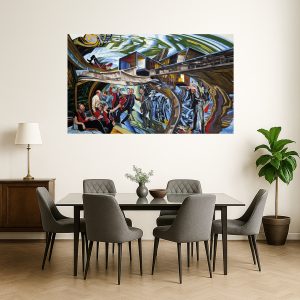
Bortolossi’s works — sometimes developed in three dimensions — tend to saturate space with a multiplicity of figures and signs, creating a true horror vacui. The artist traces this inclination to influences from Indian and Eastern art, as well as from the European Gothic and Baroque traditions. Proper names of depicted figures or famous brand names often appear, much like saints identified in ancient paintings, underscoring a short circuit between sacred and profane, high culture and popular culture.
With the introduction of the computer as a compositional tool, this tendency toward accumulation intensified further, opening the way to visual distortions and experimentation. Central to his reflection is the crisis of ideologies and the concept of “liquid society” theorized by Zygmunt Bauman — a world without stable hierarchies, where languages and values coexist on the same level. Yet within this apparent chaos, recurring architectures and discussion tables suggest the possibility of shared spaces and still-viable dialogue.
While maintaining a distinctly European perspective, Bortolossi’s work intersects with overseas phenomena such as Lowbrow art, represented by Robert Williams. The magazine Juxtapoz dedicated an extensive article to him, leading to a series of exhibitions in the United States, including a significant show at the Glassell Gallery of the University of Louisiana Museum, accompanied by a catalogue featuring a critical essay by Darius Spieth.
The Mandelli Arte Method
Mandelli Arte promotes Walter Bortolossi for the complexity and contemporary relevance of a research practice that connects historical memory and the present, philosophy and visual culture, refined imagery and popular references. His work constructs a system of free associations capable of critically reflecting on the contradictions of the contemporary world, without renouncing the painterly power and narrative force of the image.
For this reason, Mandelli Arte is proud to present Bortolossi to its most ambitious collectors, those seeking a unique and unmistakable style with a strong visual impact.
The gallery supports Bortolossi’s oeuvre through a curatorial path that highlights its internal coherence and international significance, emphasizing his ability to create a layered, ironic, and deeply cultivated visual language. This approach is further explored in Pralina No. 93, dedicated to the artist as a key to accessing his visual universe, as well as in two television episodes of the series “Praline in TV.”
For information about the works of Walter Bortolossi and his artistic journey, please contact us:
galleria@mandelliarte.com
